Develop to Green
Full-stack technology for develop-to-green strategies in German residential real estate, designed in-house at Reneo Group. The challenge was a product that had to be legible to a bank and a contractor at the same time.
- Services
- Product design, Prototype, Marketing site, Design system
- Year
- 2022 to 2025
Six parties, no shared plan.
A building with a bad energy rating passes through six parties before it has a good one. Each one holds a piece of the renovation and none of them holds the plan. That is the gap the product had to close, and the first design problem was the map of who has to agree with whom, before any screen existed.
Who has to agree
Each party reads the renovation through what it needs to act.
Contractors
Do the work, and need a plan specific enough to price and to sequence.
Component providers
Supply windows, heating and insulation, each with its own lead time.
Government authorities
Approve, and attach conditions that change the plan after it was priced.
Energy auditors
Rate the building before and after, which is what the whole case rests on.
Banks and funding institutions
Release money against a plan, and against proof that the plan was followed.
Tenants
Live in the building while it is being changed around them.
One layer between the building and everyone who touches it.
The product sits in the middle and runs four stages: identify potential, plan the transformation, orchestrate the renovation, manage the asset afterwards. Those four collapse into three things a user actually does, and the interface is organised around the three.
Three things a user does
The navigation follows the work, not the four internal stages.
Impact assessment
Find the optimum transformation plan for each building, balancing ESG and financial aspects.
Asset transformation
Plan construction measures, match with contractors and steer execution.
Value management
Manage the asset and all stakeholders before, during and after transformation.
A plan a bank can release money against.
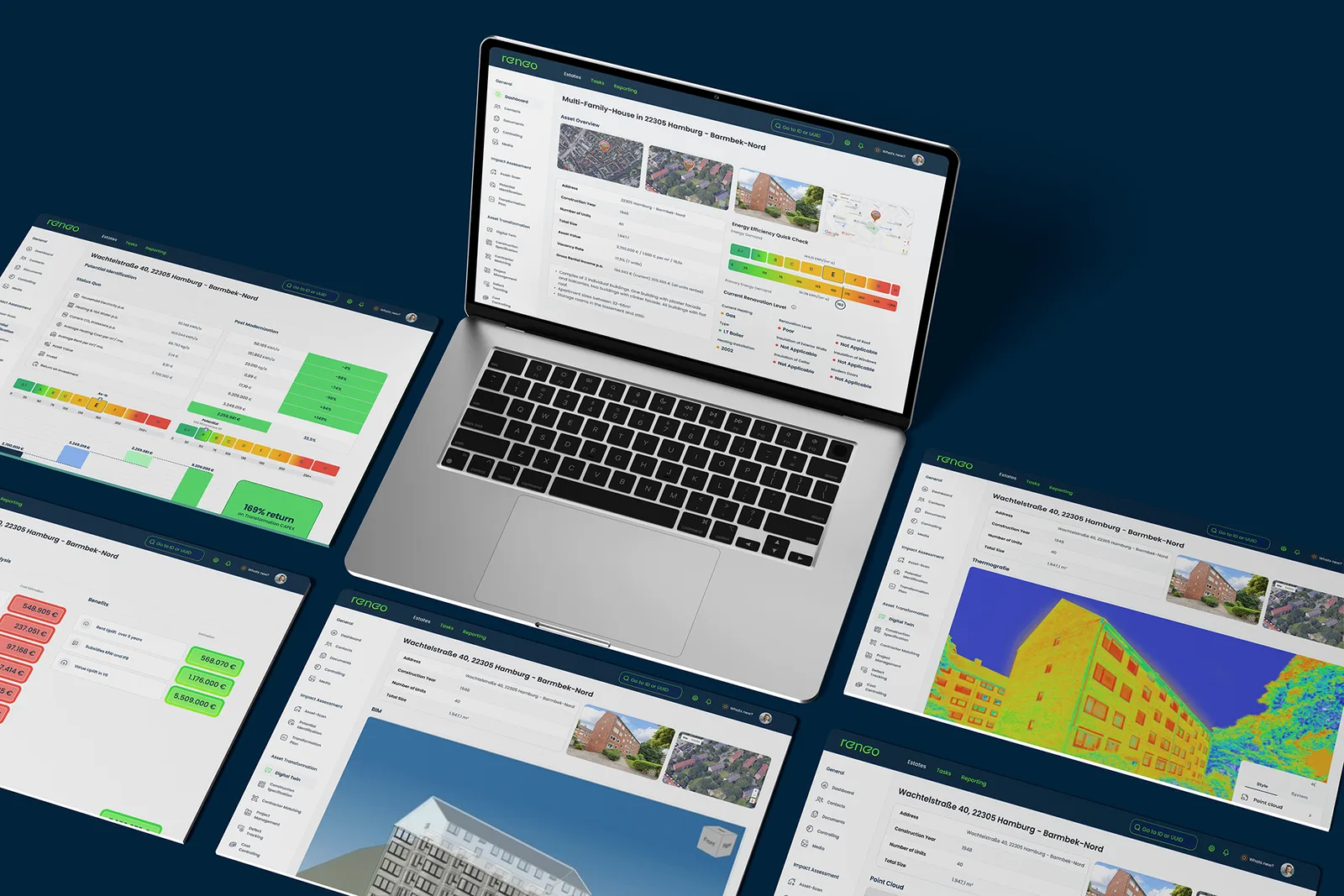
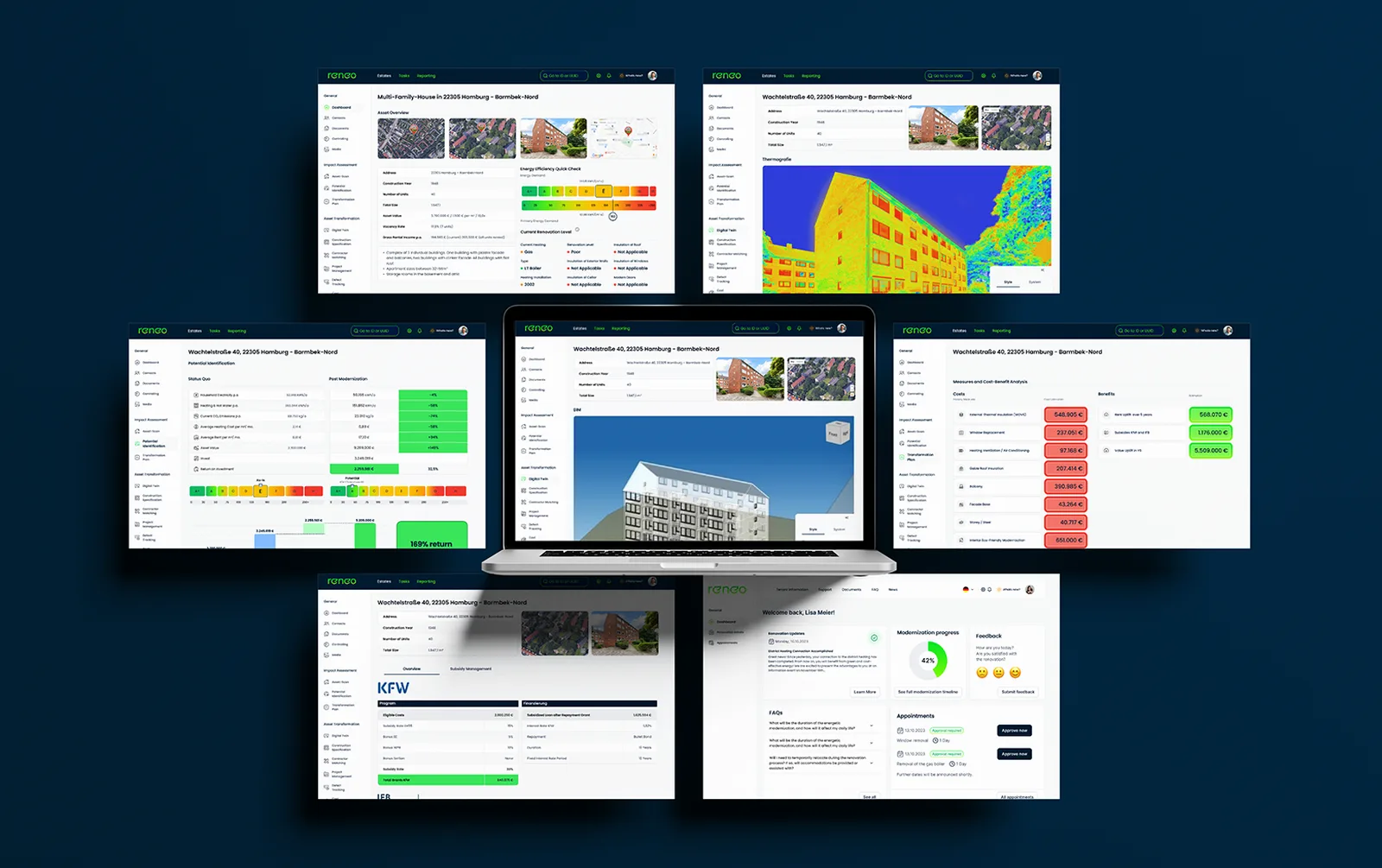
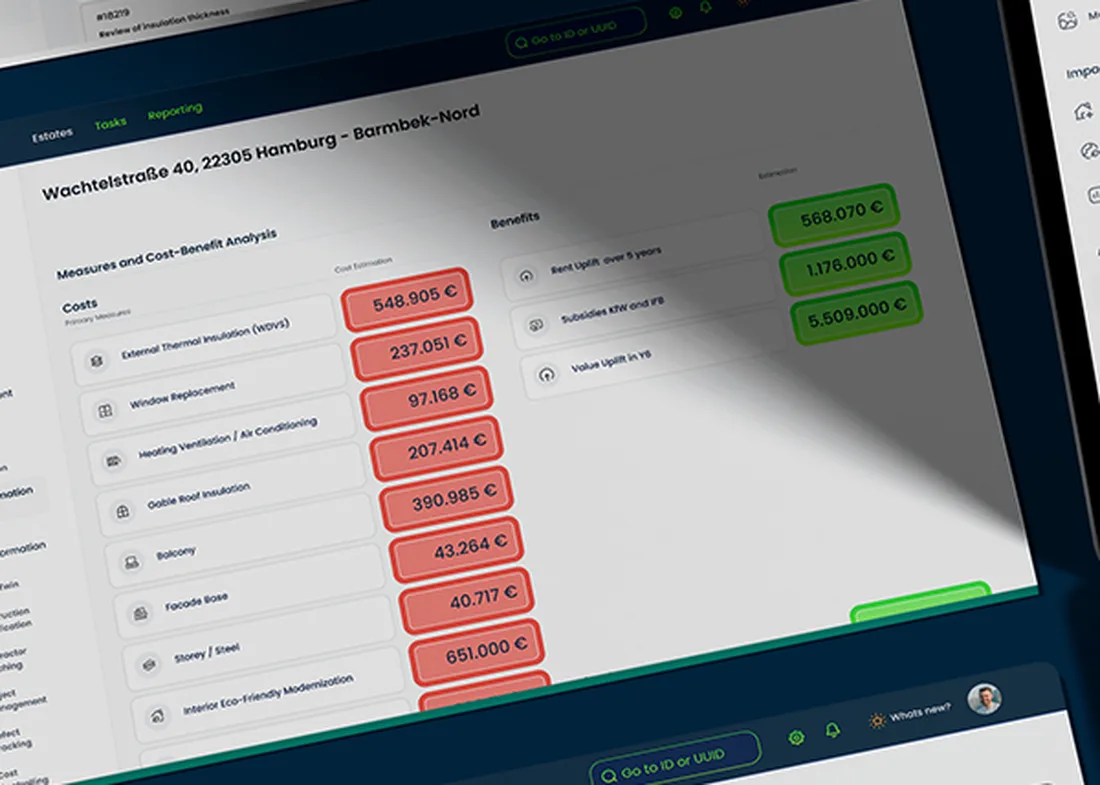
Each building opens on its current energy rating and the rating it would hold after modernisation, with the cost, the benefit and the internal rate of return attached to that same plan. Subsidy programmes sit next to those numbers, because in Germany a renovation case is decided on what the subsidy covers as much as on what the work costs. All of it belongs on the screen where the plan is decided rather than in a spreadsheet beside it.
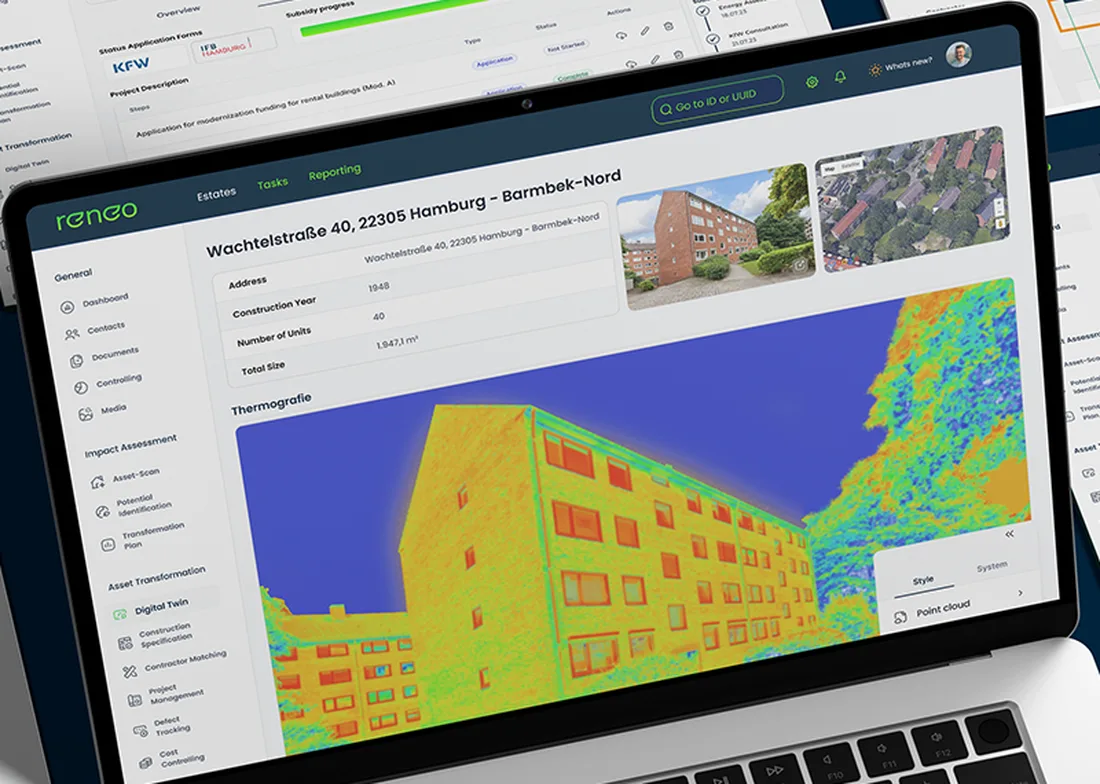
The building as data.
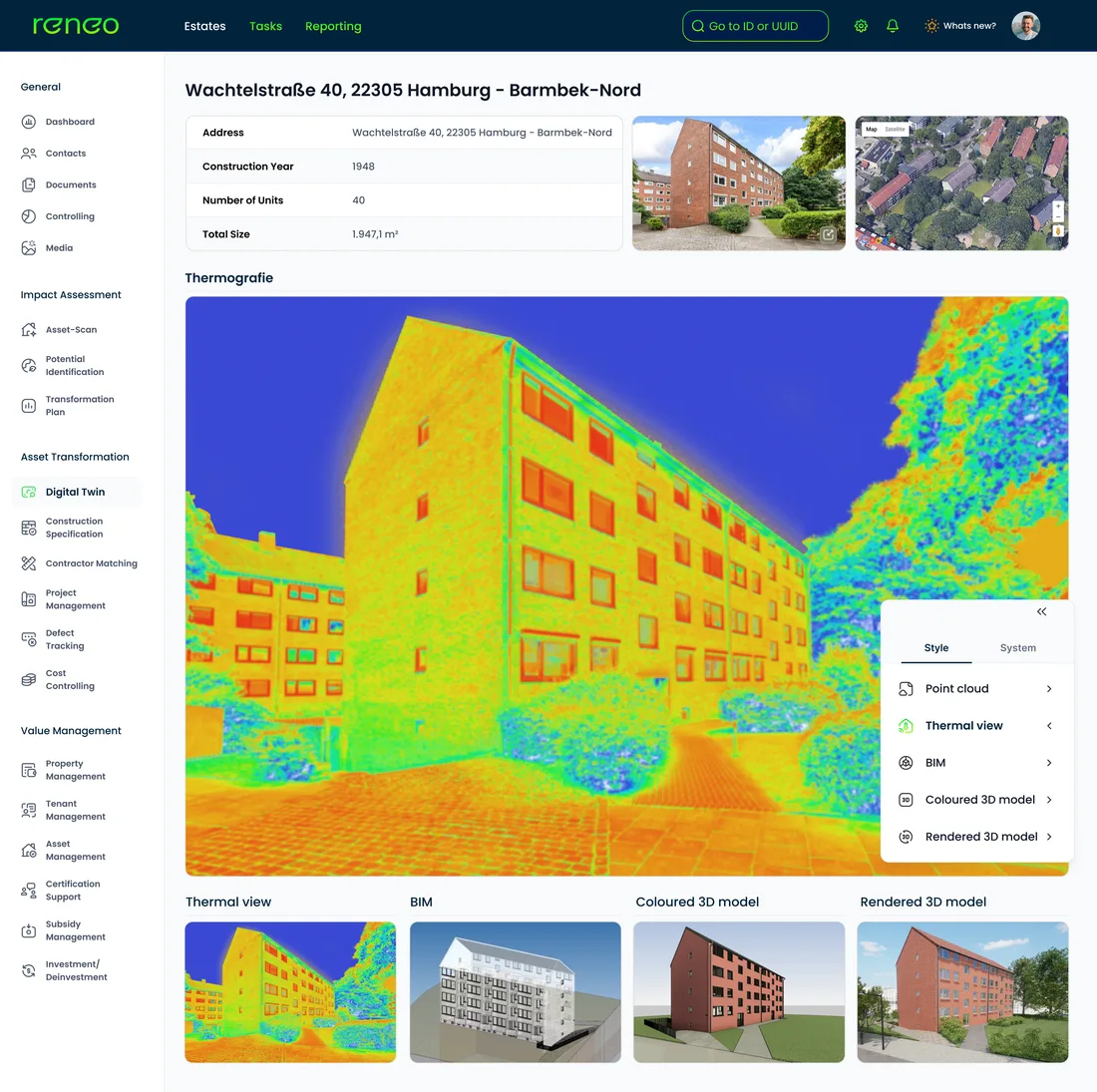
The survey enters the product as data rather than as a report: thermography, point cloud, thermal view, BIM, and coloured and rendered 3D models of the same asset, switchable from one view. From there the plan becomes a digital bill of quantities, the object contractors price against and the one the progress plan and the defect tracking are both read from.
Investors could click through it.
In February 2025 Reneo announced a €600 million capital platform for the decarbonisation of German residential real estate, including a joint venture with Peakside Capital to deploy around €500 million in debt and equity. Develop to Green was the part of that story investors could operate rather than read: the orchestration layer, the transformation plan and the asset view, working. I designed the product and the prototype that carried it. The figures belong to the company and come from its own announcement.
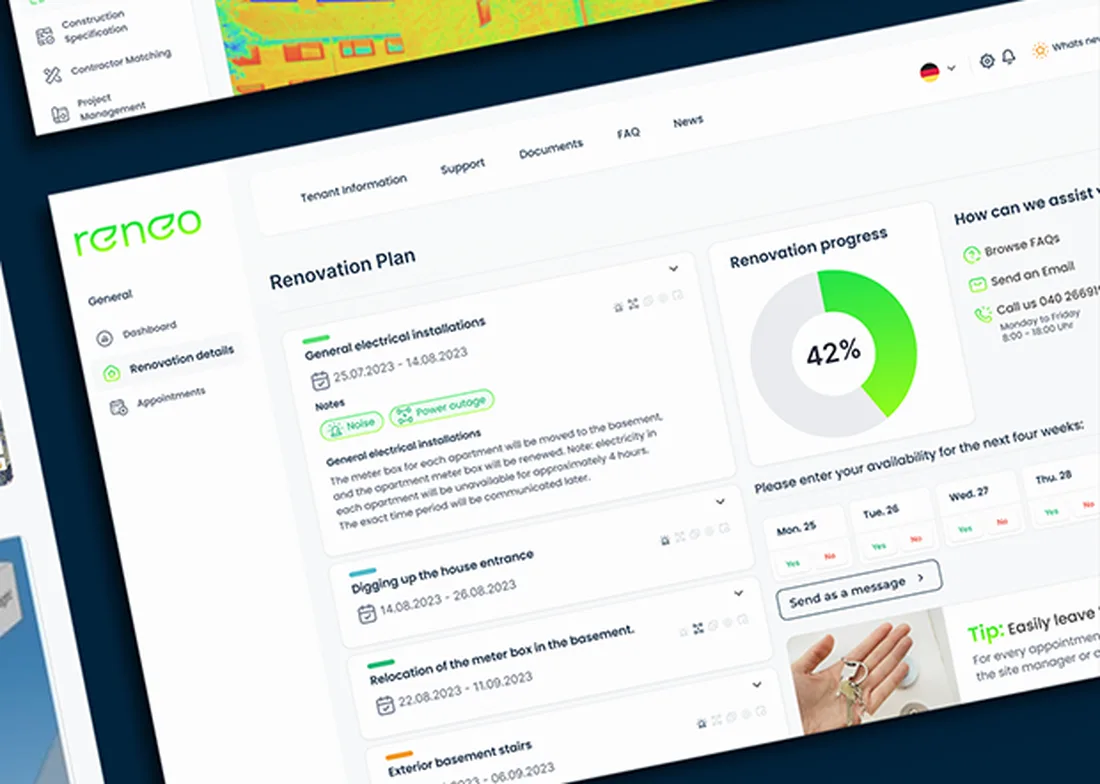
The person living through it got a screen too.
A tenant sees how far the renovation has come, enters availability for the next four weeks, answers whether the work is going well, and opens a chat when something is wrong. Renovation planning normally treats the resident as a constraint to work around. Here the resident supplies a date, which is what the construction schedule actually needs from them.
Ten weeks, repeated 750 times.
The product did not start at building scale. It started with interior transformations: a standardised construction setup plus the technology, delivered in ten weeks and repeated more than 750 times. That repetition is the argument everything else rests on, and the interface had to carry it, with the same plan, the same stages and the same reporting whatever the size of the asset.
The project in numbers
Figures from the material itself and from Reneo's public announcement.
- >750
- Interior transformations run on the same standardised setup before the product was extended to multi-family houses.
- €600m
- Capital platform announced by Reneo in February 2025, including a joint venture with Peakside Capital to deploy around €500m.
- 25m
- German units rated E or worse, the market a develop-to-green strategy addresses.
A banker and a contractor had to read the same screen.
A bank reads a transformation plan as risk and as release conditions. A contractor reads the same plan as scope and sequence. The interface could not choose between them, so the plan is the one object both of them open, with stages, costs and energy rating attached to it instead of kept in separate tools. A prototype that can be operated answers questions a slide can only assert.